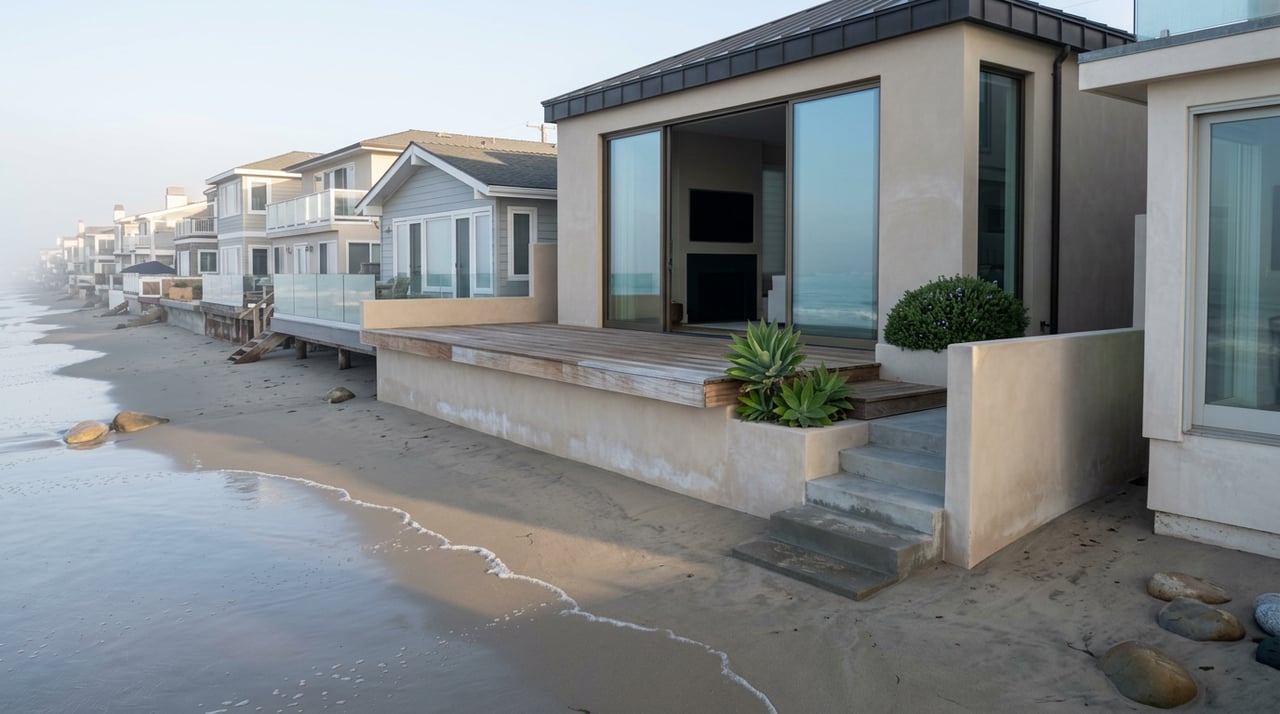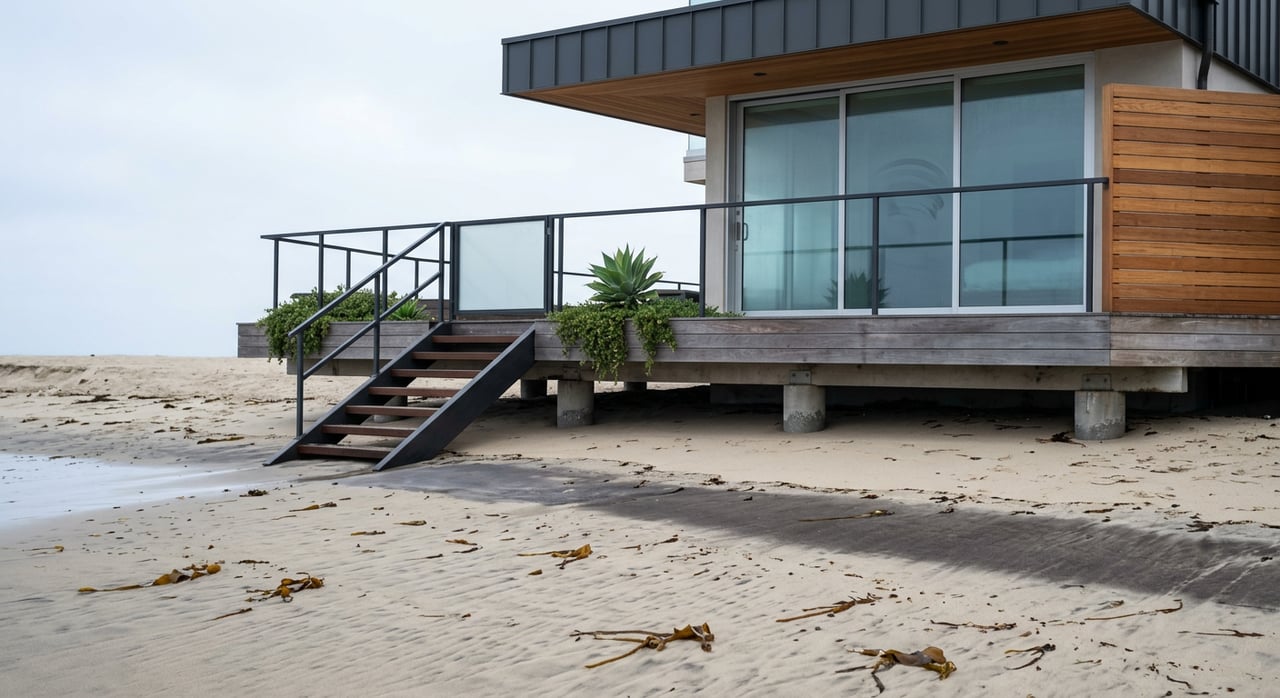
A Malibu Road house that might gain a bedroom under today's rules could lose that option under a map change the City of Malibu is now finishing. A staff report dated August 11, 2026 says it plainly: "Properties along Malibu Road that were included in Phase 3 will be moved into Phase 2." The change appears in the revised agreement between the City and the Los Angeles Regional Water Quality Control Board covering the Civic Center septic prohibition. Most of the public discussion has been about when the sewer pipe arrives. For anyone buying or selling on this stretch of coast, the more pressing question is what the house can legally become before then.
Under the City's posted review policy, the two phases follow different rules on expansion. Phase 3 homes can add bedrooms if they meet set conditions. Phase 2 homes cannot add any bedrooms until they connect. On the proposed schedule, connection is set for August 27, 2031. For a buyer pricing in a future addition, that gap is the number that matters.
Two phases, two different houses
The City of Malibu's Policy for Environmental Health Review of Development Projects within the Civic Center Prohibition Area, revised May 2020, sets out what a homeowner can build in each phase. The differences are sharpest for residential expansion.
| Phase 1 and Phase 2 | Phase 3 | |
|---|---|---|
| Adding bedrooms | Any increase in bedrooms counts as a new discharge of sanitary waste and is not allowed | May be considered if the owner meets strict criteria |
| Adding plumbing fixtures | Any increase in drainage fixture units counts as a new discharge | May be considered under the same criteria |
| Flow limits | Existing flows cannot be increased or exceed the capacity of the existing system | Added flow capped at 420 gallons per day, estimated as average residential flow |
| Septic upgrades | Repairs and maintenance allowed if they do not expand capacity | Expanded or new systems must include filtration and disinfection |
| Owner acknowledgement | Not part of the posted Phase 1/2 criteria | Owner signs an acknowledgement of the Basin Plan Amendment and the MOU |
The policy's Phase 3 section includes one more line that matters on Malibu Road. The City "will consider the construction of a new replacement residential structure on a property where an existing residential structure will be demolished as an 'existing residential structure.'" Phase 3 also has a flow formula: the first bedroom counts as two people and each additional bedroom as one, at 70 gallons per person per day. That formula is the math behind adding rooms. Phase 2 has no equivalent path to more bedrooms.
The tentative MOU confirms the baseline both phases share. The prohibition bars new onsite systems but does not bar repairs, maintenance or upgrades to existing ones, as long as they add no capacity and no wastewater flow. An owner can keep a septic system working. In Phase 2, an owner cannot make the house use more of it.
The bedroom count you can prove becomes the asset
In Phase 1 and Phase 2, the policy puts the burden of proof on the applicant. Pre-existing bedrooms and fixture units must be shown "using evidence of approved construction permits." Where the permit record is unclear, the owner needs record drawings "certified (wet signed and stamped) by a licensed architect or civil engineer." The other option is an engineering report showing that a proposed project will discharge no more wastewater than the system did before the prohibition.
On an older beach house, the bedroom count in the marketing and the count in the permit file can differ. Under Phase 3 rules, a small gap could often be closed by applying to add rooms within the 420-gallon allowance. Under Phase 2 rules as posted, the permitted count is the ceiling until the sewer connects. A seller who gathers permits, and certified drawings where needed, before listing is handing the buyer the one document that sets the house's legal size for the next several years.
The same logic changes the value of rebuild and expansion plans. A buyer who expects to tear down and rebuild larger, or to turn a den into a bedroom suite, is betting on a permitting path. Under the posted Phase 2 policy, that path runs through the sewer connection.
How the schedule got here
Phase 2 was originally due in 2024. Phase 1 was completed in 2018. In 2022 the City found significant Native American cultural resources along a planned pipeline route through the Serra Retreat neighborhood, which forced it to drop that route and redraw the project boundaries. The Franklin Fire in December 2024 and the Palisades Fire in January 2025 added more delay, according to the staff report covered by the Santa Monica Daily Press.
When Assistant Public Works Director Tatiana Holden presented the revised plan on June 8, 2026, Serra Retreat was pulled out of the Phase 2 construction path and slated for a feasibility study of alternatives. The Malibu Road properties were shifted into Phase 2. The council reviewed that draft without approving it. Mayor Bruce Silverstein and Councilmember Doug Stewart pressed to keep the original Sweetwater Mesa parcels out of interim treatment requirements. The August report then separated Sweetwater Mesa from the Serra Retreat area. It also confirmed the Malibu Road change and noted that it "do[es] not significantly increase the amount of wastewater flow for Phase 2."
The proposed milestones now run as follows:
- September 14, 2026. City Council approved technical map changes for the Phase 2 sewers, Malibu.FM reported.
- October 15, 2026, 5:00 p.m. Written comments on the tentative MOU are due to the Regional Water Board.
- November 19, 2026. Regional Water Board hearing on the tentative MOU.
- January 11, 2027. City staff's expected date for final City approval after the Board's review.
- March 26, 2029. Deadline to form the Phase 2 assessment district.
- August 27, 2029. Proposed start of construction.
- August 27, 2031. Developed Phase 2 properties must connect.
Counted from today, the proposed connection date is just under five years out. A buyer closing this winter would likely spend most of a typical first remodel cycle under Phase 2 expansion rules.
The proposed MOU also says the Water Board would not enforce the prohibition against property owners while the City substantially complies with the schedule and owners follow the applicable requirements. In practice, that means a working septic system keeps running in the meantime. The limit falls on expansion. Operation continues.
What the connection will cost is still open
No current per-parcel figure exists. The City of Malibu's January 2022 staff report is the most detailed public estimate: it put Phase 2 at $65 million in total and said owners would vote on an assessment district and pay an engineer-determined fair share over 30 years, with a no-interest prepayment option. Owners would also pay for connection work on their own parcels and for ongoing operations and maintenance. That estimate predates the cultural-resource redesign and the new map. The August 2026 report says the original design agreement with HRL Laboratories is fully encumbered and that more money may be needed to adjust the design to the revised map. Staff plan to bring a funding recommendation after the MOU is executed.
The tentative MOU says the district must be approved under applicable law, including Proposition 218, and that covered owners must then connect. For a Malibu Road parcel newly added to Phase 2, that means a future assessment vote, a future assessment and future connection work, none of them priced yet. In a purchase negotiation, that is an open cost item. It is not a known deduction.
Malibu Road has also drawn a separate cost figure. In May 2025 the Los Angeles Times reported an estimate of about $269,000 per property for a proposed sewer along PCH to serve fire-damaged beachfront homes. That figure belongs to a different project and does not apply to Civic Center Phase 2.
The part of the map nobody has spelled out
The staff report's text does not give an address range, parcel count or parcel list for the Malibu Road properties being moved. The boundary appears only on the revised prohibition map attached as Attachment 1. Malibu Road runs about two and a half miles, and the report describes the change as properties "that were included in Phase 3." For any single address, the attachment is the only authority. A street name is not enough.
Two more points remain open. The City's posted review policy dates from May 2020 and describes the phases as they stood then. Nothing published yet confirms whether it will be applied unchanged to the newly moved parcels once the MOU is final. The interim nitrogen and bacteria treatment requirement in the tentative MOU is written for Serra Retreat properties. The research found no clause extending it to Malibu Road.
Questions buyers and sellers are asking
Is the reclassification final? No. The MOU is tentative until the Regional Water Board acts after its November 19, 2026 hearing, and final City approval is expected around January 11, 2027.
Can a Phase 2 owner replace a failing septic system? Repairs, maintenance and upgrades are allowed as long as they do not increase capacity or wastewater flow. City permits are required for the work.
Does Malibu Colony face the same timeline? Malibu Colony has been in the Phase 2 area since the City's earlier project documents, so the proposed August 27, 2031 connection deadline applies there too.
What should a buyer collect before an offer? Four things: the parcel's phase on the current revised map, the permitted bedroom and fixture count backed by construction permits or certified drawings, City records on the existing septic system, and an honest list of which planned improvements would add wastewater flow.
If you own on Malibu Road or are weighing a purchase there, the parcel's phase and its documented bedroom count now carry real weight in what the house is worth. Sandro Dazzan and the team at The Agency Malibu can help you read the revised map against a specific property, assemble the permit record before you list, and set your pricing with the 2031 timeline in mind. Book a Private Consultation.
This article is general information, not legal, tax or financial advice. Consult a qualified professional about your situation.